History Snippet of Villa Spinabella

Take a look in the attached map, where I’ve drawn the circle, that ought to be more or less your property, #311. What was once a Roman villa there appears, from the map, to have spilled down several tens of meters to the SW of you. Obviously only another archaeological survey would be able to capture the whole picture.

The publication is De Rossi, G.M. 1979. Bovillae. In Forma Italiae, Regio I, Vol. 15, 298-323. Florence. It’s the most detailed and authoritative archaeological guide to the area, even though it was written at a time by which the thousands of art works that featured in 50+ villas populating the area had been illegally excavated and shipped elsewhere, include the stuff found on your property.
Attached the text corresponding to #311. A lot of material was pulled out of there in the 1800s and early 1900s, and maybe even in the 1700s by the various English treasure-hunters who were working in the area under the authority of the popes and Colonna family. De Rossi’s text mentions a modern villa on top of the ruins, and I expect that that is yours. Villa Sara (sometimes called Villa Gabrielli, the more famous villa in the area (up the hill and once owned by Sofia Loren, now owned by the “interesting” Antonio Angelucci) is further up the hill and identified in a separate entry.
So...long story short...your villa pretty much has to correspond to #311. And as you will read, it had to have been a magnificent structure, dating as early as to the age of Augustus (if not earlier) and continuing in operation through the fall of Rome.
· I’m not an archaeologist and not an ancient historian either. But by virtue of living here for over 20 years I developed an interest in the history and archaeology of the area. That interest resulted in Ancient Bovillae | University of Michigan Press. My (edited) book has the following to say about your site; A villa located in the neighborhood of Vigna Spinabella, just south of the complex discussed above (map 1.38). Originating in the age of Augustus, this villa enjoyed a prolonged period of use well into Late Antiquity. Even if almost nothing of the complex itself remains, a significant number of artifacts associated with the villa and listed by De Rossi have been recovered, most as a result of chance finds emerging from agricultural work in the area.[i] Among these are two late-antique column capitals, one following the Corinthian order for which De Rossi suggests a date "between the middle of the third and end of the fourth century," while the other is a waterleaf capital, widely known during and therefore attributable to the fourth and fifth centuries.[ii] This is our principal evidence of a late-antique phase of occupation in the villa, even though the physical evidence of these capitals has since disappeared. The author of this chapter is a distinguished archaeologist of Late Antiquity called Lucrezia Spera.
The Original Document - Translated to English Below.
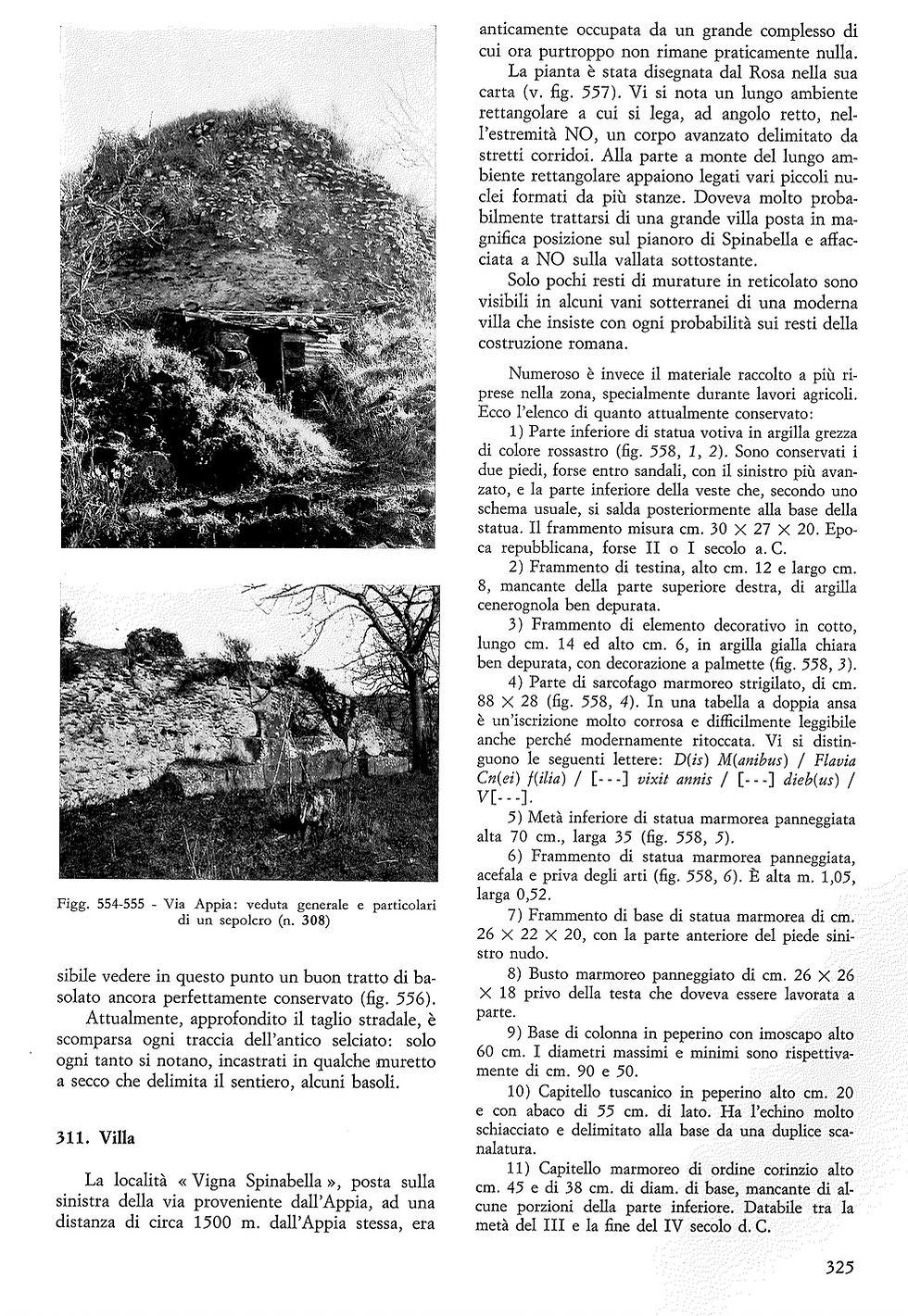


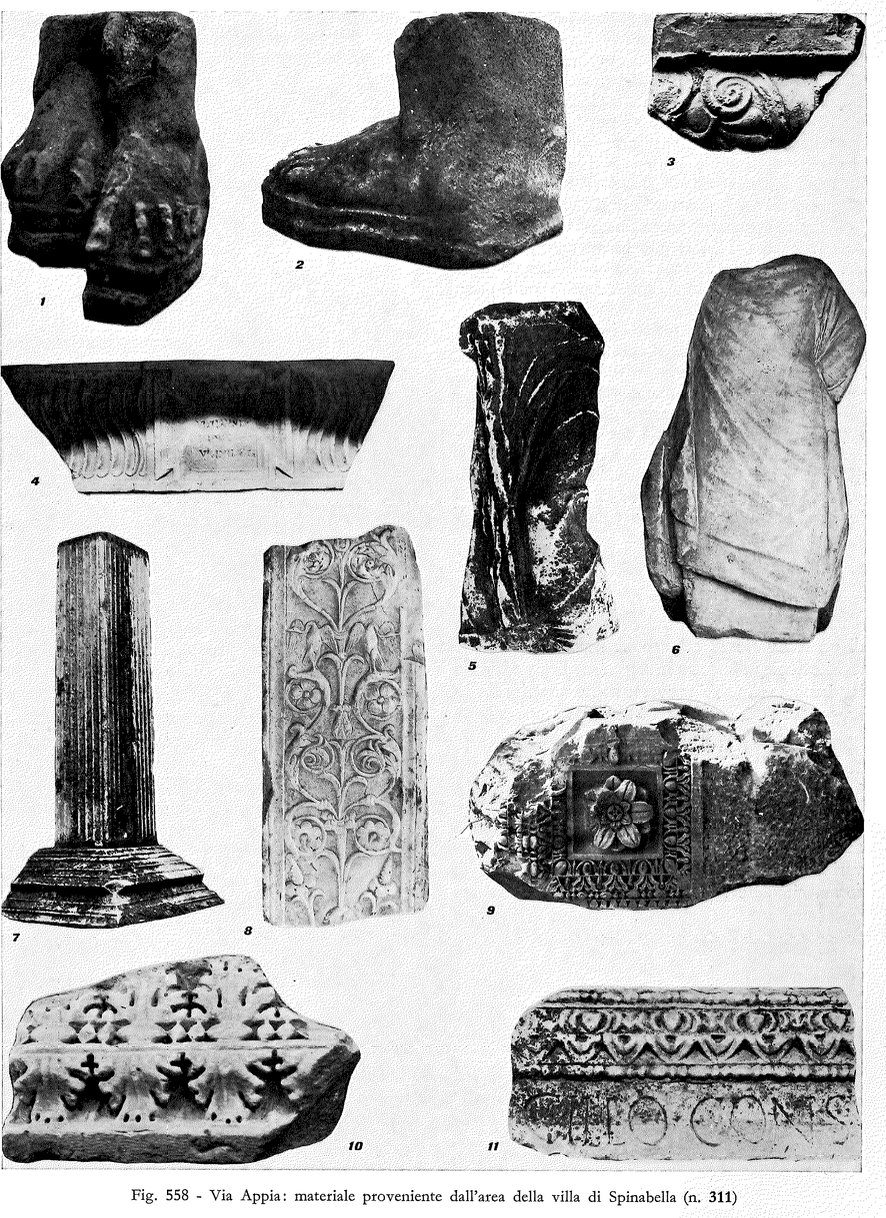
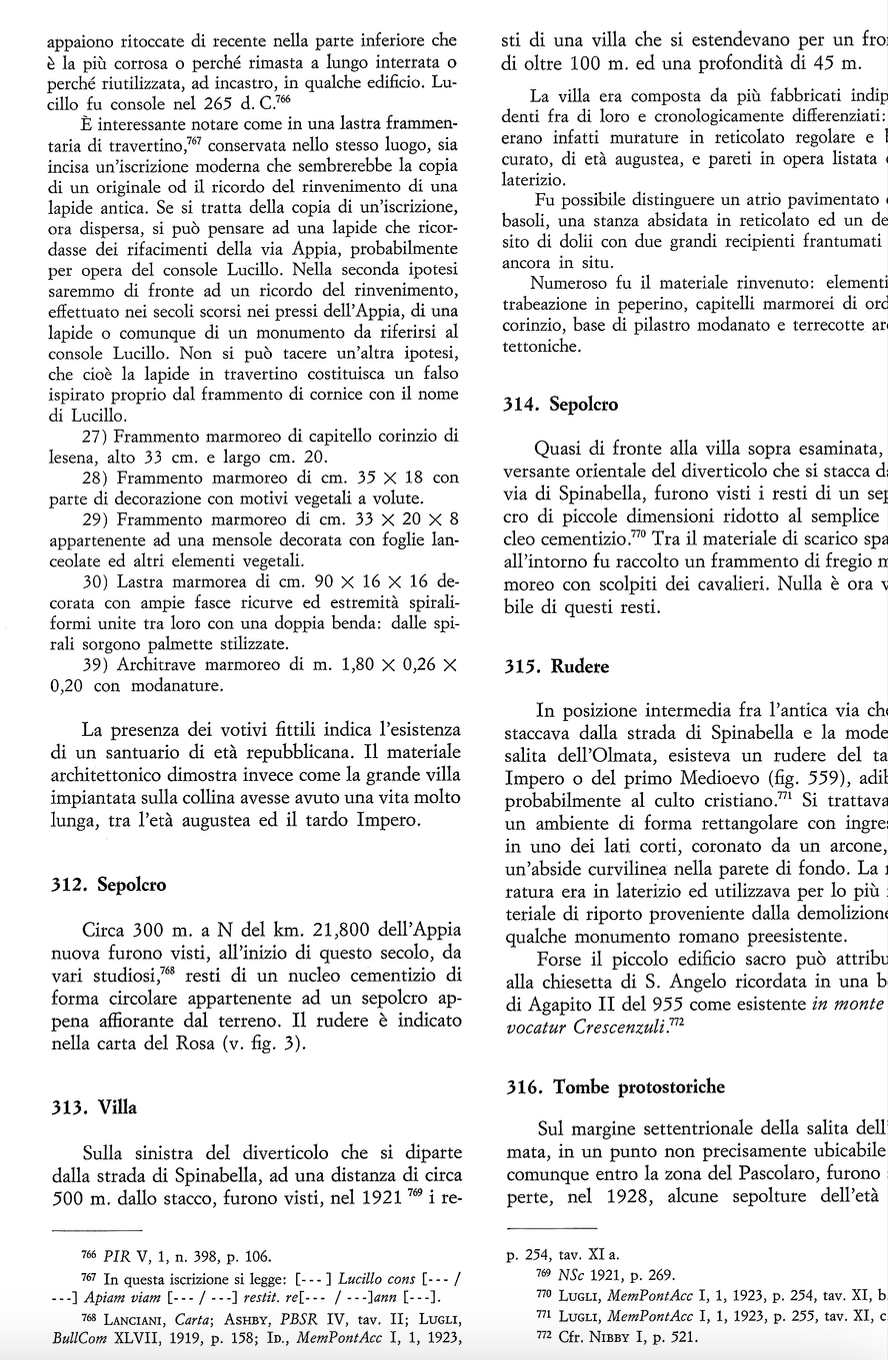
311. Villa (Villa Spinabella)
The site known as "Vigna Spinabella", located on the left side of the road leading from the Via Appia approximately 1.5 km from the Appian Way, was once occupied by a large Roman complex, of which unfortunately almost nothing now survives.
The layout of the villa was drawn by Rosa (Fig. 557). It shows a long rectangular room connected at a right angle, at its north-western end, to an advanced structure defined by narrow corridors. On the uphill side of this large rectangular hall are several smaller rooms.
The remains suggest that this was a substantial Roman villa, occupying an exceptional position on the Spinabella plateau, overlooking the valley to the north-west.
Today, only a few sections of the Roman walling in reticulated masonry (opus reticulatum) remain visible within the underground rooms of a modern villa, which almost certainly sits directly on top of the Roman structure.
Archaeological Finds
A considerable quantity of archaeological material has been recovered from the area, particularly during agricultural work.
The finds include:
Fragments of a Republican terracotta votive statue
A fragment of a clay head
Decorative terracotta architectural pieces with palmette decoration
A marble sarcophagus with a partially preserved Latin inscription
Marble statues
Marble statue bases
Marble busts
Column bases in peperino stone
Tuscan and Corinthian marble capitals
Marble columns
Decorative marble cornices
Pilasters
Architectural fragments from an important Roman building
Most of these pieces date from the Republican period through the Late Roman Empire, indicating continuous occupation over several centuries.
Historical Interpretation
The discovery of Republican terracotta votive objects suggests that a sanctuary existed here before the villa was built.
The architectural remains demonstrate that the villa itself had a long lifespan, beginning during the Augustan period and continuing into the Late Roman Empire.
The complex extended for:
More than 100 metres in length
Approximately 45 metres in depth
It consisted of several independent buildings constructed at different times.
Identifiable Features
The excavations identified:
A paved atrium
Rooms built in opus reticulatum
Storage rooms (including large storage jars, or dolia)
Marble Corinthian capitals
Peperino architectural elements
Decorative terracotta
Numerous carved marble architectural fragments
Nearby Discoveries
The publication also records:
Tomb (Section 312)
Approximately 300 metres north of the villa are the remains of a small Roman tomb.
Second Villa (Section 313)
About 500 metres from the Spinabella road junction are the remains of another Roman villa extending for over 100 metres, again dating from the Augustan period through Late Antiquity.
Tomb (Section 314)
Opposite the villa were the remains of another burial monument.
Ruin (Section 315)
The remains of what may have been a small early Christian chapel, possibly connected with St. Agapitus II (955 AD).
Why this is important for your property
This is an exceptionally significant archaeological reference because it confirms that Villa Spinabella was not simply an old country house. The site was:
A major Roman villa complex occupying a prominent hilltop position.
Built over an even earlier Republican sanctuary.
Occupied continuously from roughly the 1st century BC / Augustan period through the Late Roman Empire.
Rich in marble architecture, sculpture, and monumental building elements.
Large in scale (over 100 m × 45 m), making it one of the more substantial Roman rural villas documented along this stretch of the Via Appia.
Based on what you've previously shared about the caves, underground rooms, and surviving masonry at Villa Spinabella, this publication provides strong historical context for why the property has such archaeological significance.


Comments